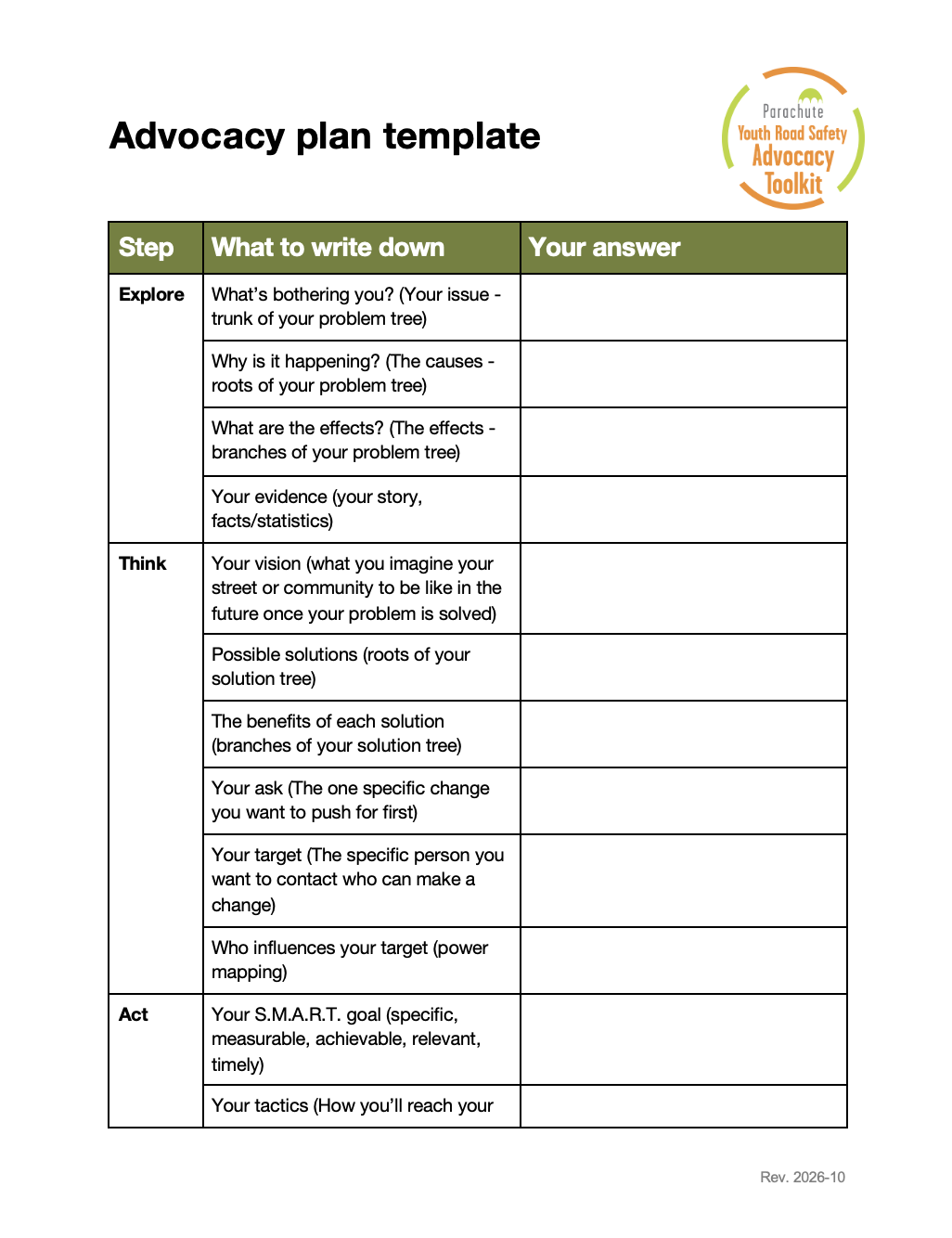
This section of the toolkit will help you turn your road safety issue and solution into a concrete advocacy plan.
Now it’s your turn to bring together everything you’ve learned and the road safety topics you care about most into one cohesive plan. Your advocacy plan will follow a simple four-step cycle:
- Explore
- Think
- Act
- Reflect
When you explore, you pick your issue and gather your evidence. When you think, you decide what change you want and figure out who can make it happen. When you act, you plan to take action and follow up. When you reflect, you look at what happened and decide what’s next.
Before you start, note this is a cycle, not a checklist. You’ll probably go through this cycle more than once, which is the point. As you go, you’ll fill in your own advocacy plan piece by piece and you may have more to add to earlier sections throughout the process.
By the end of this section, you’ll have a completed plan you can act on.
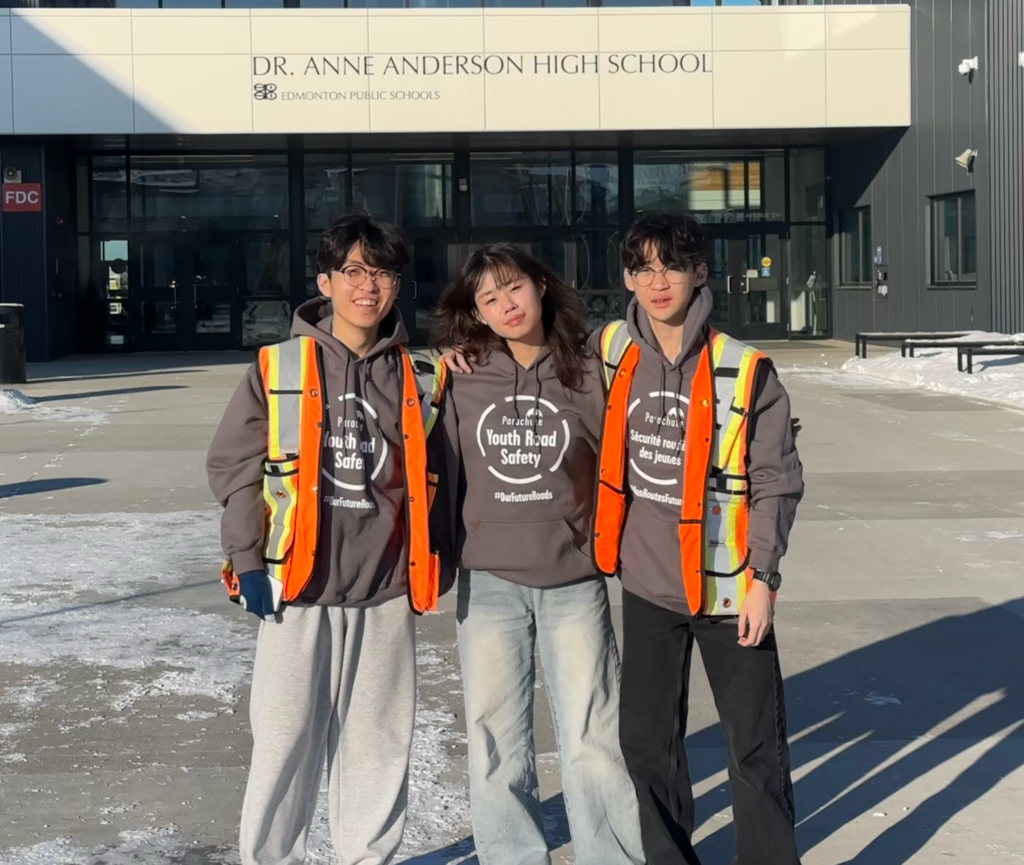
In the steps described below, you’ll follow the real story of a young Canadian advocate, Brandon Kwon, and his experience going through these steps.
Step 1: Explore
Every advocacy plan starts with one question: what’s bothering you? Think about your own life and your everyday encounters on the road. What kind of transportation do you use most, and what feels unsafe about it? Where in your community have you felt in danger? Is there a story from your own life or someone else’s that has stuck with you? Who around you is being impacted the most?
Not sure where to start? Review the page What you can advocate for and see what catches your eye. There are many road safety issues that need attention, so choose one that matters to you or affects your community. It could be a dangerous intersection, speeding near a school, a missing sidewalk, a lack of separated bike lanes, or anything else you’ve noticed in your daily travels.
Once you’ve chosen an issue, take some time to learn about it. A great way to explore it in more depth is with a problem tree, which helps you map out the problem, its causes and its impacts.
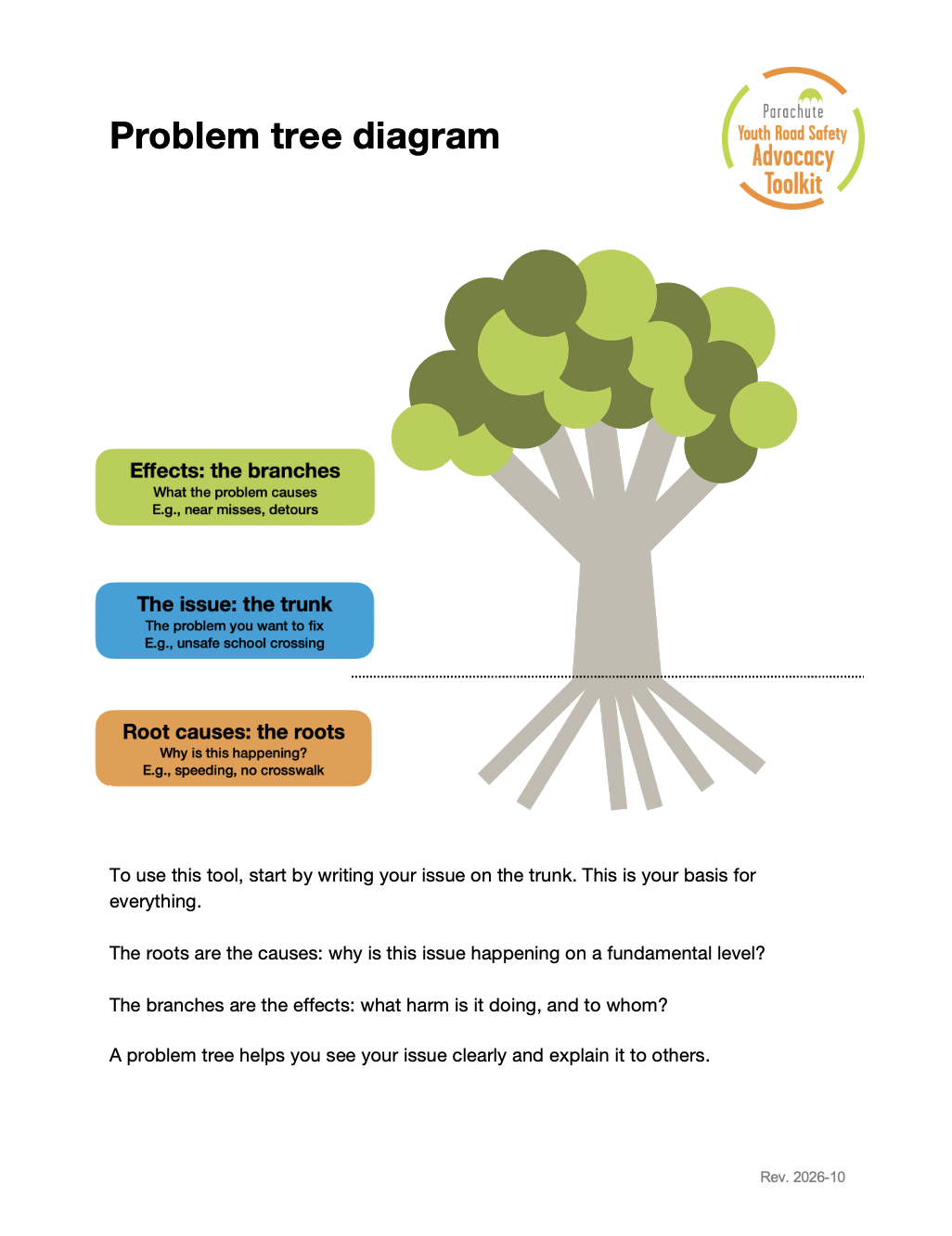
Problem tree
Next, back it up with evidence. Good evidence substantiates that this issue exists and is problematic to the community. Your own experience counts as evidence and so do the experiences of people around you. Saying “I cross this road every day, and I’ve watched three near misses this month,” is real and makes a strong impact.
It’s good to combine your experiences with facts and statistics about your issue because that’s what makes your case hard to dismiss. For example, if you pair your anecdote with local data about how the intersection has a disproportionately high number of collisions compared to other areas, your case becomes much stronger. A story helps you get heard and shows that the problem is real but a number shows it’s bigger than one person and not just one-off.
Good Canadian databases include:
- Statistics Canada
- Transport Canada’s National Collision Database
- RSS 2035+
- Parachute’s resources
- Your own city’s road safety or Vision Zero plan – find this by consulting Parachute’s Vision Zero map that lists which jurisdictions have such plans in place.
You don’t need a mountain of data. A few solid facts plus a real story go a long way. This is an opportunity to engage in conversation with their local council and municipal staff, to learn about issues they’ve identified. If the municipality already has it on their “to do” list, then your role is to advocate for public support for that change, which could help speed up the process.
I became concerned about road safety around my high school in Edmonton after repeatedly seeing congestion, speeding and drivers failing to yield near the main entrance crosswalk. Instead of relying only on personal experiences, I wanted to determine whether these concerns reflected a broader safety problem. I formed a team who has seen similar issues and collected near-miss data at our school and compared it with a nearby school that already had traffic-calming measures. We also surveyed students to understand their experiences and concerns.
Brandon Kwon
Step 2: Think
In Step 1, you identified a road safety issue in your community. Now let’s look at some possible solutions that can fix it.
Start by researching solutions
Chances are that your problem isn’t new and that somewhere, someone has already solved it. You don’t have to reinvent the wheel; all you have to do is find a proven solution that fits your community. Look at what other communities have done to address the same issue, drawing on what you already know. Review the page, What you can advocate for Make link, as many interventions are listed there.
Look at what the research says works and what your own city’s road safety or Vision Zero plan already promises. You may find one solution to your issue, or a combination; keep them all in mind as we move forward.
Write your vision for your street in one sentence
After researching your problem and possible solutions, capture your vision, which is what you imagine your street or community to be like in the future once your problem is solved. For example: “Every student at my school can cross to the bus stop safely.”
A solutions tree is one way to organize what you find. Specifically, it can help you land on the specific change you want to ask for. When your tree is filled in, you’ll find your advocacy ask: the one specific change you’ll push for. Pick the root that best fits your community, your evidence and what your city can do, as it’s going to be important in the next part of this step.
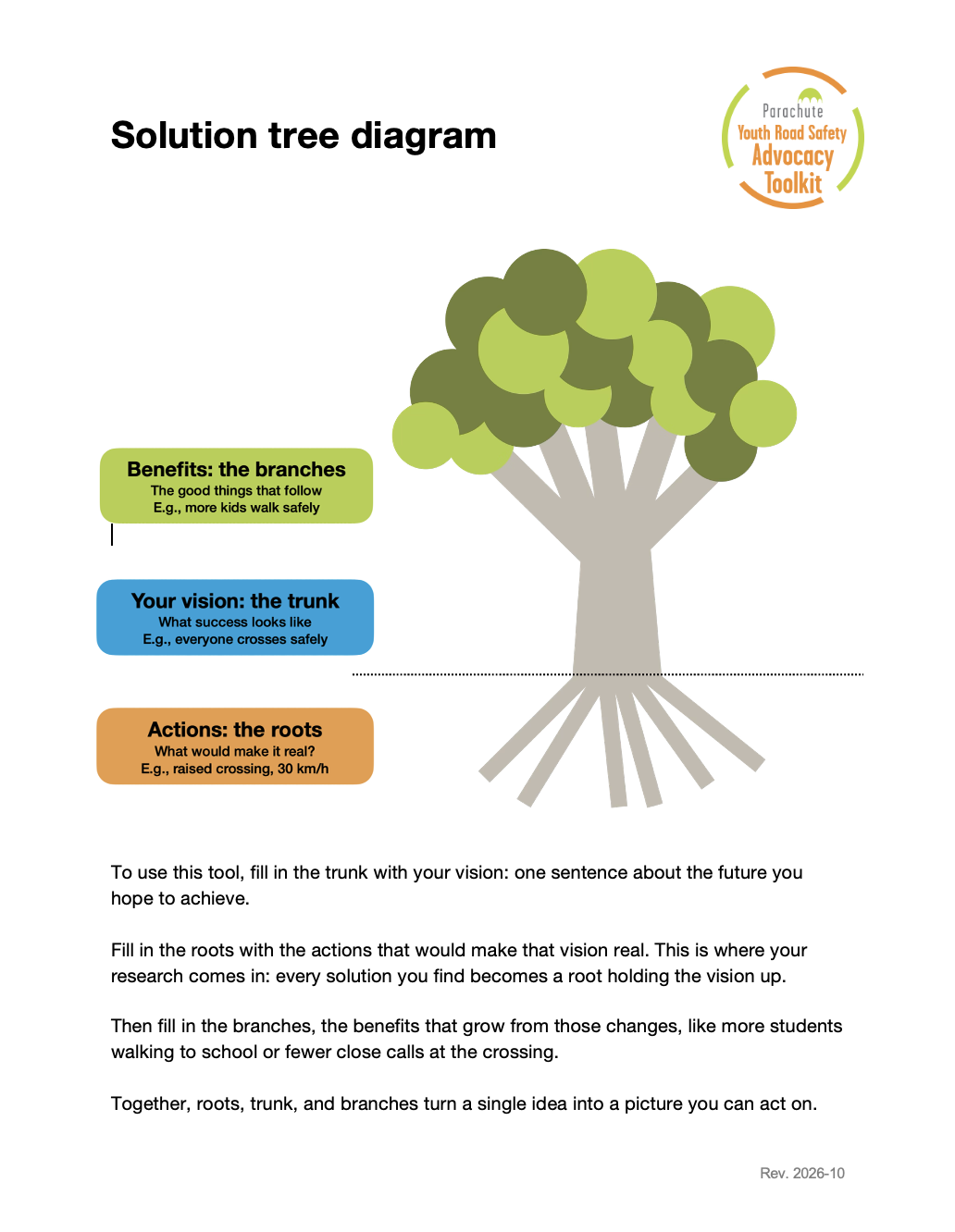
Solution tree
Find out who has the power to make your solution happen
This matters more than almost anything else because a strong message sent to the wrong person gets you nowhere. Go to the page, Understanding road safety policy in Canada add link and match your ask to the level of government that controls it.
Most likely, you will be working with the local municipal government. For example, changes to a crossing on a local street are the responsibility of your city or town.
Then get specific. Find the name of your city councillor or the staff department in charge.
- Many city websites have a “find my councillor” tool
- You can use iMatr, a free Canadian platform that finds your municipal, provincial, territorial and federal representatives based on your address
- A call or email to your city’s main line could also help discover who handles your issue
Write down a real name and contact. The person you want to look for is someone with real power over your issue who is realistically reachable. For most road safety issues, that’s a local decision-maker, not a federal minister.
Then think about who’s around your target. Who do they listen to? Who influences them? This is called power mapping. Maybe your councillor listens to the school board, local businesses or community associations. Reaching those people can be a path to reaching your target.
Finally, find your allies. Who is already working on this issue? Which friends, clubs, teachers or organizations could stand with you? A collective voice is hard to ignore. One person asking for a safer crossing is making a request. A school pointing out that a thousand students cross that road every day is a problem the city has to answer. Institutional backing, such as from a school or a club, is powerful.
Our goal was to use evidence to advocate for practical changes that would make the school zone safer. After analyzing the observations and survey responses, we found that our school had a significantly higher near-miss rate. Speeding, congestion, and unsafe crossings were also common concerns among students. We collaborated with the school principal, local police, and the City of Edmonton as they helped with key decision-makings that helped support changes to traffic flow, signage, and road infrastructure.
Brandon Kwon
Step 3: Act
It’s time to make your move. This step turns the ask you landed on in Step 2 into a concrete plan: a clear goal, the right tactic to reach the right person and a way to follow through.
Set a SMART goal
The whole project hangs on a goal sharp enough to act on, and that sets the tone for the entire project. Take the ask you picked in Step 2 and turn it into one clear goal and make it SMART.
- S – Specific: name the exact change and place. Not “safer streets” but “a raised crosswalk at John Street and Holmes Avenue.”
- M – Measurable: you should be able to tell whether it happened. A crossing is either approved, or it isn’t.
- A – Achievable: pick something within reach for your group and your timeline. One crossing, not every crossing in the city.
- R – Relevant: it should connect directly to the issue you care about and the people it affects.
- T – Timely: give it a deadline. “By the end of the school year” turns a wish into a plan.
Put together, that creates a goal: “Advocate for a raised crossing to be approved at John Street and Holmes Avenue by the end of the school year.” Compare that to “fix traffic congestion,” which is vague, has no finish line and gives you no way to know if you’ve succeeded. A SMART goal tells you exactly what you’re aiming at and when you’ll know you’ve hit it.
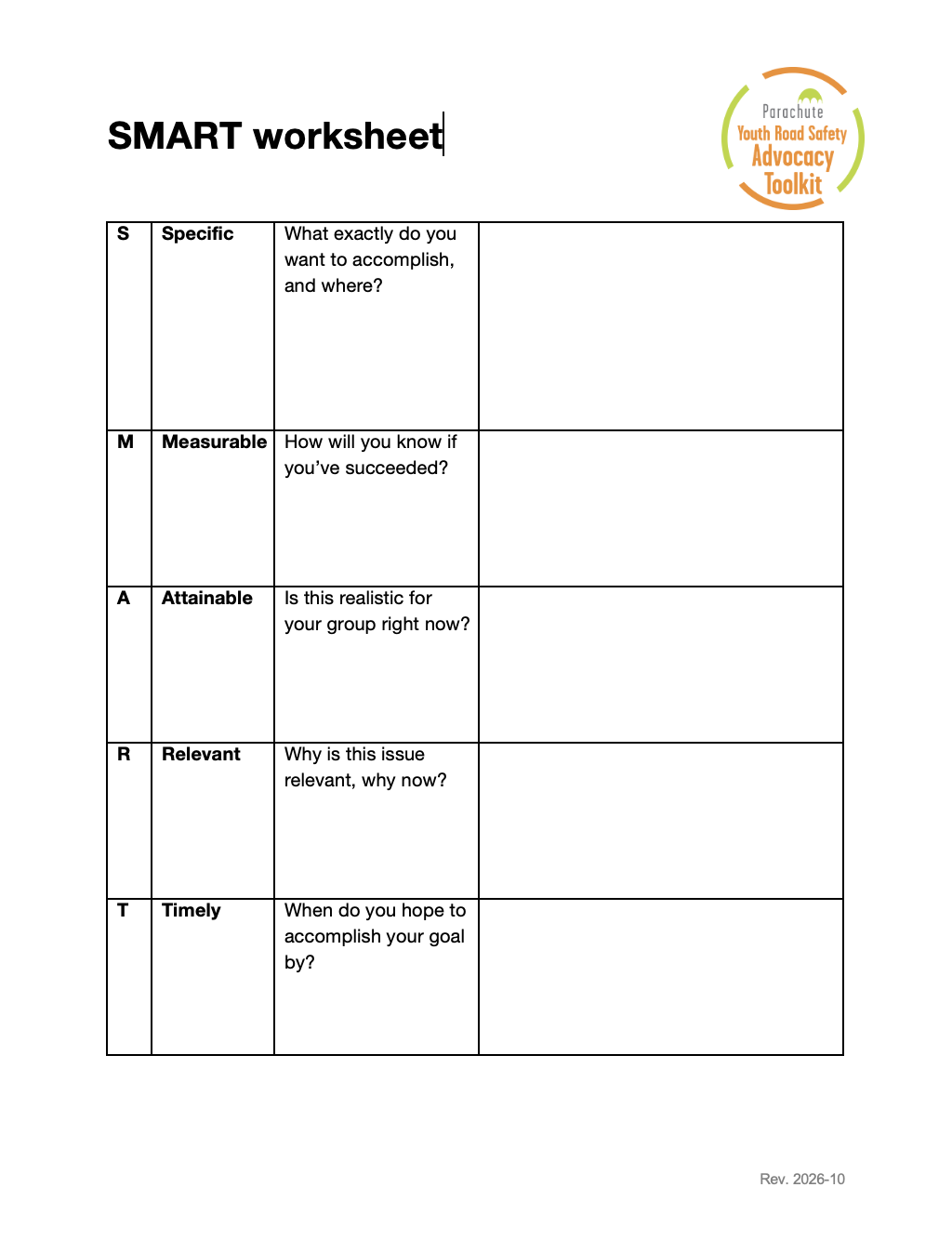
SMART worksheet
Reach your intended audience
Next, choose how you’ll reach your decision-maker or the people who influence them. There are many ways to be heard:
- a letter
- an email
- a social media campaign
- a meeting request
- a media interview
Pick the one or two that best fit your target audience and your goal, and do them well. The how-to for each, including templates you can make your own, is covered on the page Strategic communications.
Consider: Depending on how approachable the decision maker is, it may be better to connect with them earlier in your process as they could be an excellent ally to have in your corner from the start.
Make an action plan
Map out who is doing what and by when. Write out your action plan: if you’re working with others, split the jobs and give yourself deadlines to send emails or reach out to media, so the plan doesn’t drift.
At the same time, think about what could go wrong. Maybe the decision-maker doesn’t reply, maybe there’s no room in this year’s budget, maybe your own schedule gets busy. You can’t plan for everything but knowing the likely hurdles in advance makes them easier to handle.
Then, do it. Connect with other organizations. Send that letter. This is the moment the whole plan has been building toward.
Follow up
Here’s the part too many people skip. Advocacy doesn’t end when you hit send. Emails to the city can get buried or land in spam, and a message with no follow up is easy to forget.
If you haven’t heard back in a couple weeks, a polite nudge is appropriate. If you get a reply, look for a commitment: did they agree to do something, and by when?
Keep track of all of it, along with the replies, meetings and signatures you gather along the way. Decision-makers are far more likely to act when they know someone is watching and will follow up.
We prepared a presentation summarizing our findings and proposed several improvements, including clearer lane markings, stronger no-stopping restrictions and a curb extension near the main crosswalk. We first presented our findings to the school principal and an Edmonton Police Service officer. We then contacted the City of Edmonton and requested a site visit. After reviewing the area, the city agreed to convert the existing time-restricted no-parking zone into a permanent 24-hour no-stopping zone.
Brandon Kwon
Step 4: Reflect
After you’ve done the hard work, look at what happened honestly. Did the decision-maker or person with influence reply, commit or act? Did they follow through on what they said? What worked and what would you do differently? Use what you tracked in Step 3 to answer with facts, not just feelings.
If you didn’t get the change you wanted, that’s not failure. It’s still an important step, and you still got people thinking. Maybe the timing was off or the ask was too big for a first try. Even a “no” tells you something you didn’t know before and you can use it. If you receive a positive response to the solution you are advocating for, evaluate the results to see whether your vision is being realized.
Now decide what’s next:
- Keep pushing with a clearer ask
- Try a different tactic or target
- Hand the issue off to allies
- Take a well-earned break
All these are valid responses. Advocacy is an ongoing effort, not a one-time event, and the cycle loops back to Explore whenever you’re ready.
If I completed the project again, I would begin data collection earlier and observe more locations over a longer period. I would also involve additional schools and gather feedback from parents, drivers, and nearby residents. This experience taught me that youth advocacy is most effective when personal experiences are supported by clear evidence, realistic recommendations and consistent follow-up.
Brandon Kwon
Advocacy Plan template
Now that you’ve made it through the whole cycle, it’s time to put all the pieces together. We’ve created an advocacy plan chart template for you to use. Fill in each line with what you found in steps one to four. You’ll walk away with a practical, actionable advocacy plan for the cause you care about.