Now that you’ve built your plan, let’s make sure your message actually lands. This section covers how to craft a message that convinces people to back your cause and how you can deliver it.
Build your message
Before you send anything, post anything or say anything out loud, you need to know exactly what you’re trying to say. You did your hard thinking following the process outlined on the page, Building your advocacy plan.This is about distilling your thoughts into a message that will move someone. Get this part right and the rest gets a lot easier.
Crafting a strong advocacy message
Every strong advocacy message has three important jobs.
- What do people need to know? One or two facts that show the problem is real.
- Why should they care? This is where you can tell a story to back up the facts.
- What do you want them to do? Your specific ask.
If your message covers all three, it works almost anywhere. If it’s missing one, the audience learns, or feels, or acts, but not all three.
Tone and approach
How you say it matters as much as what you say. Stay positive and objective, leading with facts, not blame. Ask questions instead of assuming; you’ll learn more and put people less on the defensive. Resist the pull toward aggression, even after being ignored. It might feel satisfying but it shuts conversations down instead of opening them up. A calm, persistent voice builds the credibility that gets things done.
Know your audience
The same message can land differently depending on who’s hearing it. A politician wants to know what their constituents care about and how much it costs to act. Your peers and general public respond to stories, energy and what this means for their daily lives. Before you write anything, always think to yourself: who is this for and what do they care about? That way, your message can be perfectly tailored to convince your audience.
Lead with a story
A statistic almost always lands better and is remembered when paired with a real story. A number shows the problem is big but a story makes it real. Tell it in the first person, set the scene so people can picture themselves there and keep it short. Pair that with strong facts and make your ask: that combination will go a long way.
Choose your medium
You already decided which one or two tactics fit your target and goal. This part is the how-to for each. You don’t need to use them all: just do the ones you picked well.

An email or letter to decision-makers
A letter or email can be one of the most effective ways to reach your target.
- Keep it short: a busy councillor should see your point quickly.
- Say who you are, name the problem with one piece of evidence, tell your story in two or three sentences and make your specific ask.
- Request a response. If you don’t hear back, follow up.
We’ve created an advocacy email template you can make your own.
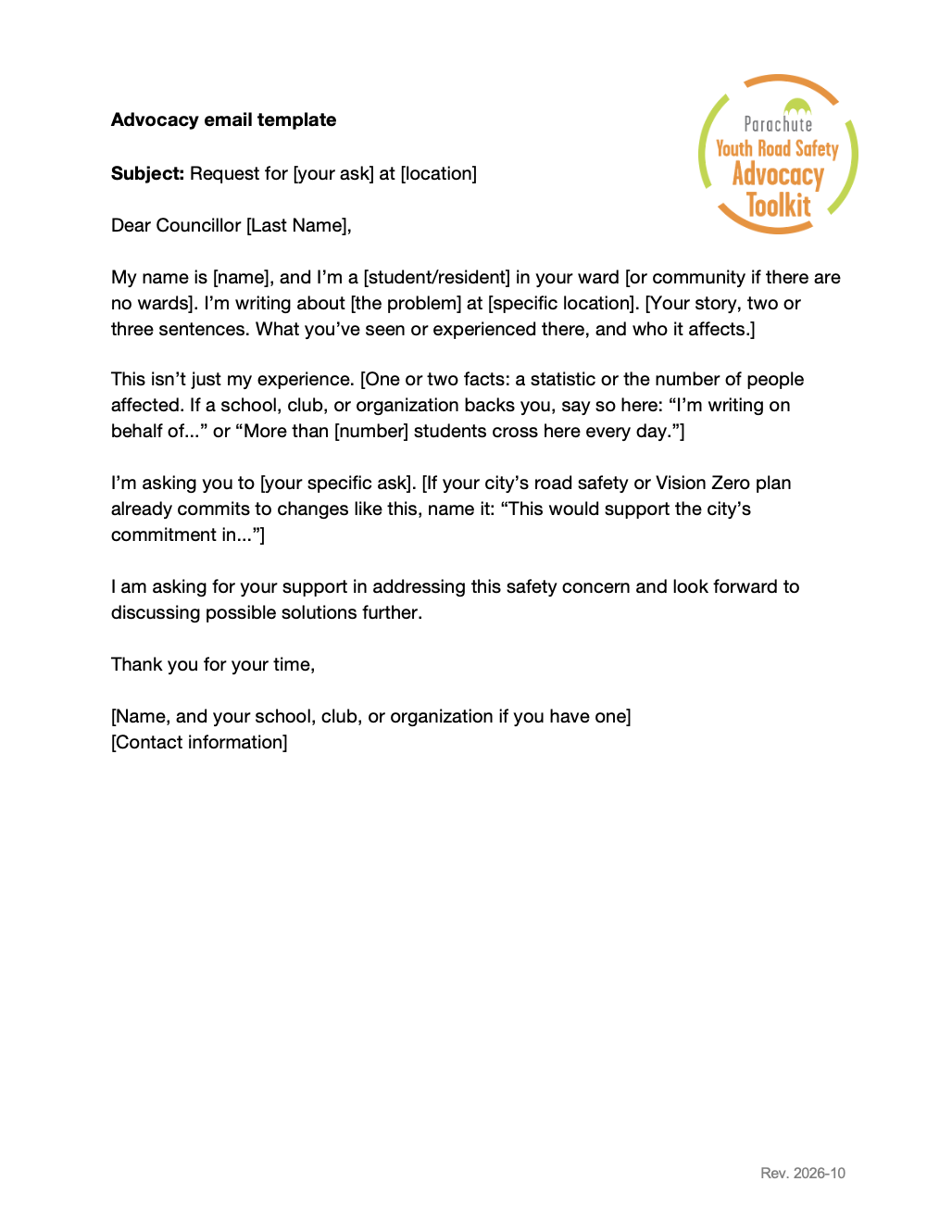
Advocacy email template

Meeting with decision-makers
If/when you land a meeting with a decision-maker, how you show up matters just as much as what you say.
- Bring a short briefing document to leave behind with your ask, key facts and contact info so they have something to refer to after the meeting.
- Show up on time and end on time
- Having a set agenda can help keep the conversation on track
- Know your specific ask going in
- Send a brief thank-you note after to recap the discussion and next steps

Public speaking
Speaking about your cause at an event or in front of a council can be scary but thorough preparation can help you overcome that fear.
- Just like your written message, the general structure should look like this: open with an engaging story, present your points with supporting facts and end with your ask
- We recommend you write down everything you want to say on paper, practice it out loud a couple of time, and time yourself so you know your speech fits the time you’re given
- Going with jot notes so your speech isn’t too rigid and presenting with cue cards can work as well
When speaking, it’s natural to get nervous, but try not to fixate too much on the audience and focus on delivering your message. If you’ve done the work, there’s nothing to be scared of, everything you’re saying is real and you know it better than anyone.

Social media
Social media is where a lot of your peers are, so meet them there.
- Make an account dedicated to your cause and keep posts short, visual and focused on one message each
- Post consistently rather than all at once; reminding people that something exists is key
- Tag your target and your allies
- Use your own story and real photos from your community, because your actual dangerous intersection is always going to work better than a stock photo
Remember what social media is for in advocacy: building support and pressure. It helps to have more people behind you, but it doesn’t replace sending that ask directly to the person who can act on it.

Posters, graphics and video
A good visual travels further than a paragraph ever will and can be used on social media or in print. Free tools such as Canva make decent design fairly easy. Just keep this in mind: one key message per graphic and make your ask visible. If someone sees your poster for two seconds, they should still know what the issue is and what you are advocating for. Short videos work the same way: hook them in the first few seconds, one message, clear ask.

Traditional media and interviews
Local newspapers, radio and community news sites often look for real stories from real people. One story about your campaign in the local news can do more to reach your target than a dozen emails.
Start small by contacting a local news editor or journalist: tell them your name, tell them about your cause, what you want to achieve and end with a request to talk more, perhaps in an interview.
If you get an interview, great! That’s an incredible opportunity to spread your message. Decide on your one core message before any interview, state it early and don’t be afraid to repeat it. Repeating yourself might feel awkward but remember that you may be clipped at any time, so it’s important to reiterate your message.
Also, if you don’t know something, don’t be afraid to say that and offer to find out, which always beats guessing. And no matter where the questions wander, bring them back to your core ask, since you want your core message to be clear wherever the interviewer takes you.
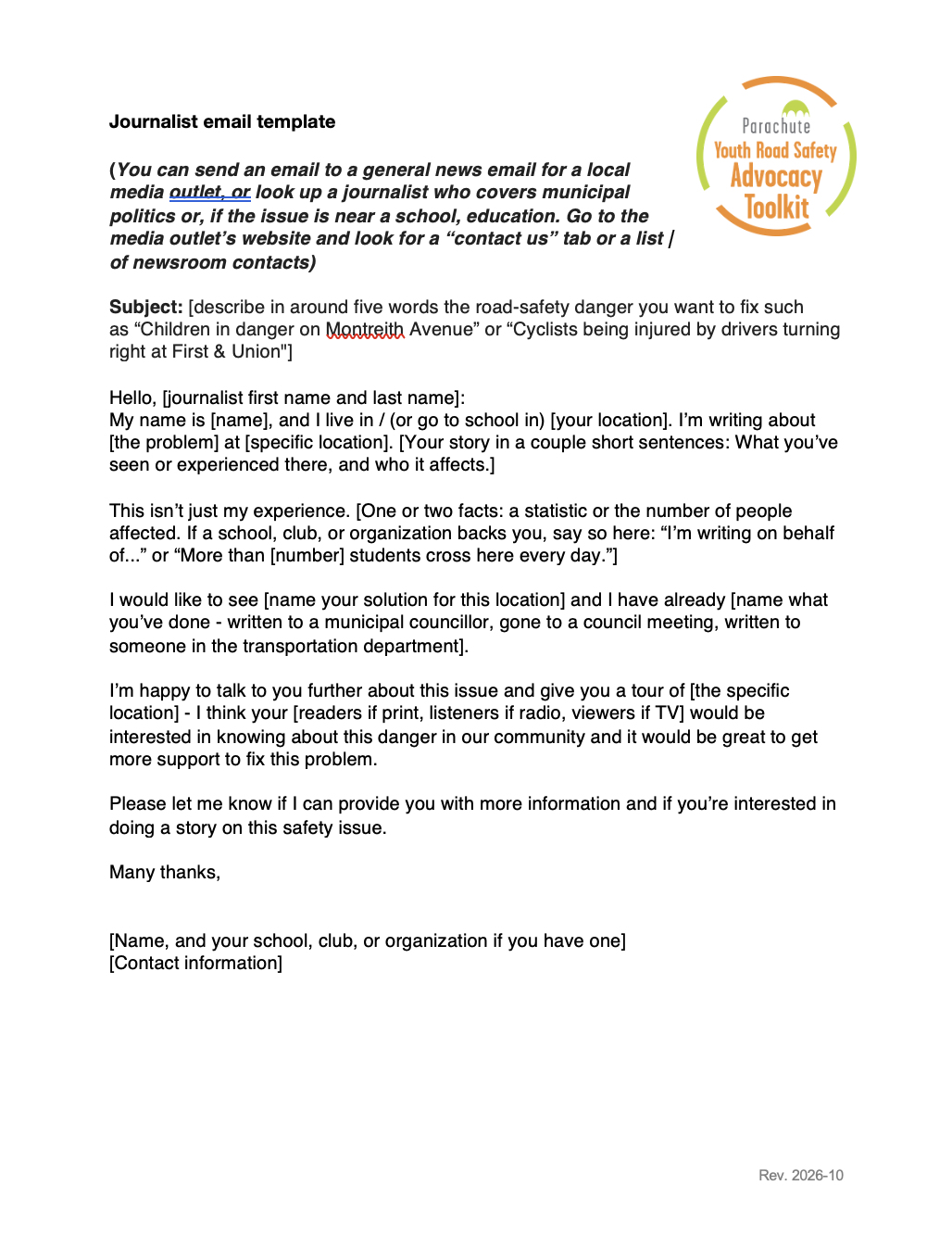
Journalist contact email template
Communication in action
That’s a lot of stuff to process, so let’s watch some of it at work. What you’re about to read comes straight from a young person in Parachute’s Snap for Change program: he spotted a danger in his community, filmed it, proposed a fix and sent a letter to the person who could make it happen.