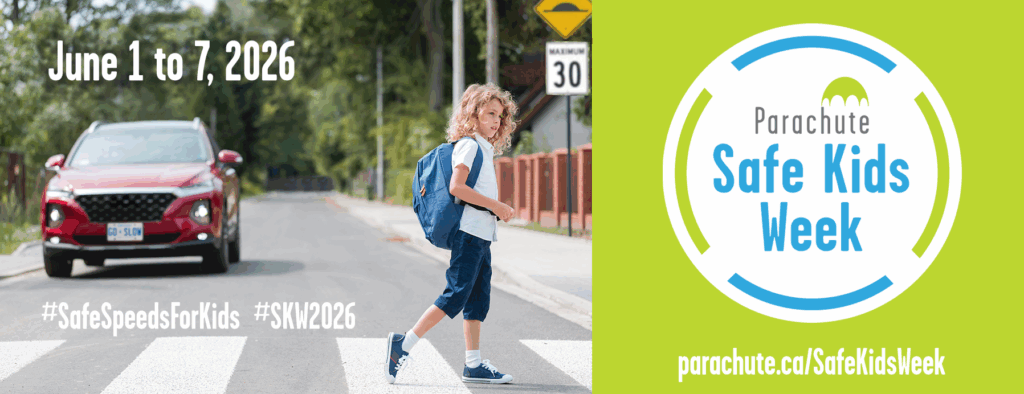
Parachute Safe Kids Week is an annual awareness campaign designed to bring attention to predictable and preventable injuries in children. Parachute celebrates Safe Kids Week from June 1 to June 7, 2026, this year with the theme of #SafeSpeedsForKids.
Primary Hashtag: #SafeSpeedsForKids
Secondary Hashtag: #SKW2026
Below are sample posts you can use on all social media channels (X, Facebook, Instagram, Bluesky, Mastodon). You are also welcome and encouraged to come up with your own tweets and messages that make sense for your organization and your community.
Please note that X posts can only be 280 characters in length (including links). We also encourage you to download and add these Safe Kids Week 2026 Social Media Images to your posts, to catch your readers’ eye.
Sample posts to use before the start of Safe Kids Week:
- Save the date! Safe Kids Week runs June 1-7, 2026. This year’s focus: Reducing speeds so kids can walk, roll and ride safely in our communities. Join us! parachute.ca/safekidsweek #SKW2026 #SafeSpeedsForKids.
- Save the date: June 1 – 7, 2026 is #SKW2026! We’re raising awareness and sharing information about predictable and preventable injuries in children. Be part of it. parachute.ca/safekidsweek #SafeSpeedsForKids
Sample posts to use during Safe Kids Week (June 1 to June 7, 2026):
- DYK? Transport incidents are the leading cause of injury-related death and the third-leading cause of injury hospitalizations and emergency department visits in children from birth to age 14. It’s #SKW2026. Learn more: parachute.ca/safekidsweek #SafeSpeedsForKids
- Every year in Canada, we see an average of 6,700 injuries and 46 deaths to children on our roads. #SKW2026 is designed to bring attention to predictable and preventable injuries in children. parachute.ca/safekidsweek #SafeSpeedsForKids
- Most child pedestrian injuries and deaths occur in urban areas. When a pedestrian is hit on a rural road, however, the result is more likely to be fatal because of higher vehicle speeds, lack of proper pedestrian walkways and larger distance to a trauma centre. Learn more: parachute.ca/safekidsweek #SafeSpeedsForKids #SKW2026
- Slower streets save lives. In areas where people live, walk and play, speed limits of 30 km/h help protect children and other vulnerable road users. Learn more about #SafeSpeedsForKids: parachute.ca/safekidsweek #SKW2026
- Most child pedestrian and bicyclist injuries and deaths occur during the after-school hours between 3 p.m. and 6 p.m. Learn more: parachute.ca/safekidsweek #SafeSpeedsForKids #SKW2026
- June has the highest number of child bicyclist injuries and deaths. Generally, these injuries happen in spring and summer when children are riding most often. Learn about #SafeSpeedsForKids #SKW2026parachute.ca/safekidsweek
- We can create #SafeSpeedsForKids. Children are twice as likely to be struck by a car in areas with speed limits higher than 50 km/h, compared to limits under 50 km/h. Learn more at parachute.ca/safekidsweek #SKW2026
- Even small reductions in speed can be significant in preventing crashes and reducing the severity of injuries. For each 1.6 km/h reduction in average speed, collisions are reduced by 5%. Learn more at parachute.ca/safekidsweek #SafeSpeedsForKids #SKW2026
- A pedestrian struck by a car traveling at 50 km/h is almost six times more likely to be killed than a pedestrian struck at 30 km/h. The risk may be even higher for children. Learn about#SafeSpeedsForKids #SKW2026 parachute.ca/safekidsweek
- Lower speeds help keep kids safe on their travels. Driving at lower speeds prevents crashes. If crashes happen at lower speeds, people involved are less likely to be severely injured or killed. parachute.ca/safekidsweek #SafeSpeedWeek #SKW2026
- Plan and use safe routes, where possible. When walking or wheeling, you and your kids are safest away from motor vehicle traffic. Learn about #SafeSpeedsForKids #SKW2026 parachute.ca/safekidsweek
- Check your ride. Ensure your child’s bike is adjusted correctly for their height. Have them do a bike check before riding to ensure tires are inflated and brakes are working properly. parachute.ca/safekidsweek #SafeSpeedsForKids #SKW2026
- Choose the right car seat or booster seat for your child and make sure it’s used properly for every single ride. When travelling by car, children are less likely to be severely injured when the right car seat, booster seat or seat belt is used on every ride. parachute.ca/safekidsweek #SafeSpeedsForKids #SKW2026
- Drivers: slow down where kids live, learn and play. Driving at lower speeds gives you more time to react and reduces the risk of severe injuries if a crash happens. Learn how we can create #SafeSpeedsForKids. parachute.ca/safekidsweek #SKW2026
- Be alert for kids on the road. Children can move suddenly and may not always judge traffic speed or distance accurately. Slow down, stay focused and expect kids to be kids. #SafeSpeedsForKids #SKW2026 parachute.ca/safekidsweek
- Safer roads start with better design. Traffic calming measures like speed humps, raised crossings and roundabouts help slow drivers and reduce crashes. Learn how road design protects kids. #SafeSpeedsForKids #SKW2026 parachute.ca/safekidsweek
- Speed cameras work. Automated speed enforcement can reduce speeding in school zones by up to 45%. Slower traffic helps create safer streets for children and families. Learn more: #SafeSpeedsForKids #SKW2026 parachute.ca/safekidsweek
- Give cyclists space. Children riding bikes need room to move safely. When passing cyclists, slow down and leave enough distance. Everyone has a role in creating #SafeSpeedsForKids. parachute.ca/safekidsweek #SKW2026
- Walk with younger children. Children develop the skills to navigate more complex traffic environments around ages 9–11. Until then, walk together and practise safe crossing habits. #SafeSpeedsForKids #SKW2026 parachute.ca/safekidsweek
- Teach kids how to cross safely. Practise stopping, looking and listening for traffic. Cross at corners or marked crossings and wait until vehicles come to a full stop. #SafeSpeedsForKids #SKW2026 parachute.ca/safekidsweek
- E-scooters aren’t for kids. They move fast and require physical strength and decision-making skills. Children under 16 should avoid e-scooters and build skills on bikes or kick scooters instead. #SKW2026 #SafeSpeedsForKids
- After school is a high-risk time for kids on the road. Most child pedestrian and bicyclist injuries happen between 3 p.m. and 6 p.m. Slow down and stay alert during these busy hours. #SafeSpeedsForKids #SKW2026 parachute.ca/safekidsweek
- See a street that feels unsafe for kids? Join #SnapForChange. Take a photo, share what would make the area safer and help advocate for safer streets in your community. Learn more: parachute.ca/ snapforchange #SafeSpeedsForKids #SKW2026
- Your voice can help create safer streets. Through #SnapForChange, people in Canada are sharing photos of roads that need safer speeds, better crossings and improved design. Submit your photo today. #SafeSpeedsForKids #SKW2026 parachute.ca/snapforchange
If you have any questions or need some guidance, please feel free to contact Parachute’s social media team at socialmedia@parachute.ca.