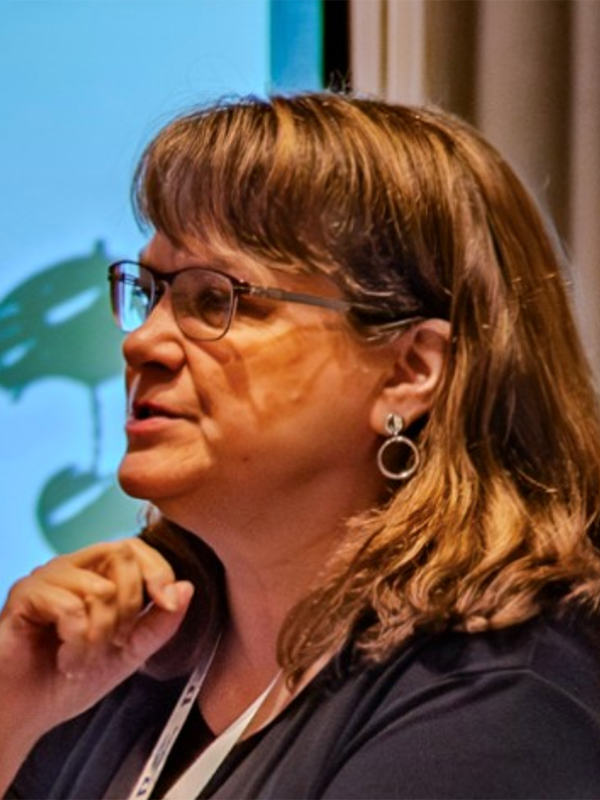
Morag MacKay is the Chief Research and Network Officer at Safe Kids Worldwide and has worked in child injury prevention for over 35 years in Canada, Europe, and the U.S. Her work has focused on research, surveillance, program development and evaluation, and helping translate evidence into effective policies and practice.
How did you get into the field of injury prevention?
When I was working on my master’s thesis – which had nothing to do with injury – I attended a biostatistics and epidemiology conference in Quebec City. Dr. Barry Pless, a noted paediatrician, gave this brilliant plenary talk about a massive public health issue without naming it. He had charts, pie graphs, evidence – and only halfway through did he reveal he was talking about injury. I was hooked.
After my degree, I worked in cancer epidemiology. Important work, but the impact was distant: stop smoking now to prevent cancer decades later. I had no fire in my belly. Then I saw a job posting for a surveillance co-ordinator at the Injury Prevention Centre in Alberta. It merged my love of data with this emerging issue Barry had awakened for me. I got the job, and that lit the fire that’s carried me for 35 years.
Your undergraduate degree was in nursing, right?
Yes. My undergraduate training was in nursing, and my graduate degree specialized in epidemiology within medical science.
What was it about injury prevention that kept you engaged early on?
The potential for immediate impact. If you get the right intervention – safe sleep space, car seat installation, helmet – into the hands of a family today, you can prevent a tragedy tomorrow. We hear stories constantly: a family had a seat installed properly and got into a crash weeks later, and everyone walked away. We struggle to measure population-level impact because of weak data and limited evaluation capacity. But at the individual level? The impact is very real.
What are some of the biggest changes you’ve seen over your career?
Several major shifts:
- In the ’90s, child injury became a Centers for Disease Control and Prevention (CDC) priority in the U.S., sparking a wave of research that took us through the early 2000’s, especially in child passenger safety.
- Evidence from those studies directly changed practice: longer rear-facing booster seats, improved legislation.
- Harborview Medical Center’s systematic reviews pushed us to be more evidence-driven.
In Canada, the Collaborative Centres (Triple C) formed—mostly women—creating national co-ordination out of thin air. Our discussions led to the first injury prevention curriculum in Canada. - Those early years were foundational. We built networks, systems and national strategies that hadn’t existed before.
Why did you stay in the field, despite the frustrations and barriers?
Two big reasons:
Children. Focusing on child injury prevention keeps me grounded. Protecting kids feels like protecting the future. I don’t have children myself, so this is how I give back.
Endless learning. Injury prevention is inherently multidisciplinary. There’s always a new angle: behavioural science, engineering, biomechanics, advocacy, systems change. I never stop learning. And the people are passionate, mission-driven, collaborative. That matters.
Collaboration is such a defining feature of this field. Why do you think that is?
The field is small. We all know each other. And honestly, it’s largely carried by women. Women tend to bring a relationship-based, ego-down, community-up approach—and that’s exactly what this field requires. There are a few “peacocks,” sure, but most people genuinely want to share, support and connect. New staff quickly learn: the Shalina here is the same Shalina everywhere. Same with Kathy. Same with Andrea. It’s a tight-knit community.
Do you have a standout memory or milestone moment?
Yes. Barry Pless once approached me to help organize a national meeting in Ottawa. We gathered leaders from across Canada and briefed a senior federal bureaucrat. After listening, he said something that stuck with me forever: “You’re asking me to put a tabletop down, but I don’t know where the legs are.” That visual shaped everything. We needed to build the legs: national co-ordination, shared frameworks, surveillance systems. And we did. For a time, we were close to having a national centre for injury prevention. Politics shifted, but the progress we made – team grants, national conferences, collaborative networks – was extraordinary.
How do you feel about the future of injury prevention?
Oddly enough, I’m hopeful. When things look bleak, you can either despair or innovate. Barriers force creativity. In the U.S., the dismantling of the CDC injury centre is devastating. But it’s also pushing collaboration, resource-sharing and strategic alignment.
Programs such as T4CIP (Trainees for Child Injury Prevention – a year-long training program for medical students, residents and fellows) give me hope: exposing medical students and trainees early to child injury prevention, something most of us working in injury prevention never had. In Canada, similar challenges persist: chronic underfunding, unstable surveillance, no national strategy. But we’ve always been scrappy. We’ve always fought uphill. And we’ve achieved incredible things despite the barriers.
If you could wave a magic wand and change one thing in injury prevention, what would it be?
That injury prevention be recognized as a human rights issue. If safety were treated as a right:
- Universities would teach injury prevention.
- Funding would reflect the burden of injury.
- Surveillance systems would be strong and stable.
- Policy action would accelerate.
We’ve done so much in spite of systemic neglect. Imagine what we could achieve with proper legitimacy and resources.