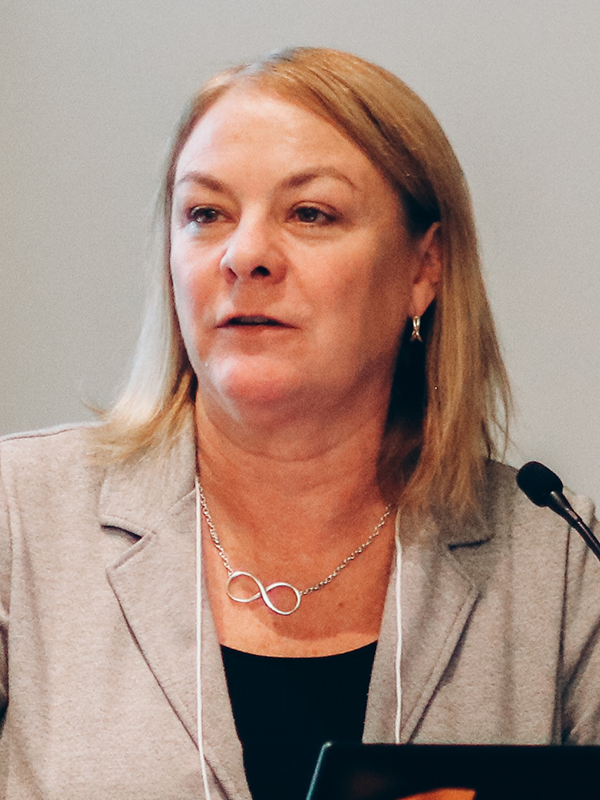
Alison Macpherson is a Professor in the School of Kinesiology and Health Science and an Adjunct Senior Scientist at the Institute for Clinical Evaluative Sciences (ICES). Her research is related to keeping children active, healthy, and safe.
How did you get into injury prevention? What really attracted you to this field?
Honestly, I never planned to work in injury prevention. I was managing admitting and registration at the Montreal Children’s Hospital when the Canadian Hospitals Injury Reporting and Prevention Program (CHIRPP) was introduced. I already knew Dr. Barry Pless — my first and greatest mentor — because he knew my father. I made sure my staff supported the program, and I saw firsthand the value of capturing children’s injuries across the spectrum from minor to major trauma.
After my first maternity leave, the hospital underwent budget cuts and abolished my role. Through a Quebec program that funded managers to retrain, I decided to study epidemiology. I asked Barry to supervise my master’s degree at McGill, and even though he insisted I didn’t need to ask him out of obligation, I truly wanted to work with him. His intelligence, directness, and honesty shaped me profoundly.
From there, I worked as an epidemiologist on planning the McGill University Health Centre, moved to Toronto, completed my PhD at the University of Toronto while working with Pat Parkin and Teresa To at SickKids, and later completed a postdoc at ICES. A friend then sent me a job posting at York University’s School of Kinesiology. Even though I wasn’t a kinesiologist, they hired me — and I’ve never looked back.
So what drew you specifically to the injury field — enough to choose it for your PhD topic?
Barry was the reason. He won the Order of Canada for his injury prevention work, and he opened my eyes to the enormous potential to prevent harm. I’ve always been drawn to under-resourced areas and underserved problems. I’ve also always cared deeply about child health. Injury is the leading cause of death in children, and so many tragedies are preventable — a life jacket, a proper car seat, a window guard. I couldn’t imagine losing a child and wondering what could have been done differently. My father was also an epidemiologist passionate about equity. Growing up, I watched him fight for safer environments for low-income families — closing beaches due to E. coli, banning smoking in restaurants, reducing air pollution and lead exposure in vulnerable neighbourhoods. His influence and Barry’s together shaped my passion for prevention, equity and protecting children.
How long have you been working in the injury prevention field?
Over 30 years. I started with Barry shortly after having my eldest daughter.
What have been the biggest changes you’ve seen in the field during that time?
A few major shifts:
- Public acceptance of safety measures has increased – helmets, car seats, booster seats. Early on, people argued these were infringements on personal freedom. That’s changed.
- The pendulum swung too far for a while, especially in low-income areas, where parents sometimes became afraid to let their kids play outside due to violence or unsafe environments.
- Equity trends have shifted. Early research showed children from poorer families were at greater risk of injury. Now, in many mechanisms, wealthier children appear more likely to show up in emergency data — but that’s not necessarily good news. It may reflect:
– low-income parents keeping children indoors due to safety fears
– undiagnosed injuries like concussions
– limited access to active outdoor play or organized sport - Pedestrian injuries remain a major inequity issue. In communities with wide, fast roads — such as around Jane and Finch in Toronto — children face much higher risks.
- Infrastructure and policy improvements, such as traffic calming and bike lanes, work — but we still haven’t fully solved these complex issues.
- Overall, injury remains a deeply intertwined equity and systems problem.
How do you feel about where the field is now — are you hopeful?
Yes, especially on the research and academic side. There is a bright, talented group of trainees, postdocs, and junior faculty entering the field. Working with them is one of the joys of my job. We’ve seen big wins: evidence-based policy, new approaches to traffic safety, and stronger intersectoral collaboration. For example, in Toronto, equity-based approaches are now influencing traffic calming decisions — a seismic shift. But we still face challenges: retiring leaders, limited leadership pathways in nonprofits, and unstable funding. Government cuts — like those affecting the CDC injury group in the U.S. — worry me. A single high-profile tragedy often spurs action, but prevention shouldn’t rely on tragedy.
Why have you stayed in this field for so long? What keeps you here?
Hope. And the belief that our work matters. We still have so far to go. Injuries remain a leading cause of death and disability. But every improvement — a policy change, a safer street, a life saved — reinforces why the work is worth it. And of course, the people. The collaboration in this field has grown tremendously compared to the early, more adversarial days. Today, researchers, clinicians, nonprofits, government partners — we work better together. Organizations like Parachute do things researchers can’t, especially in knowledge translation and national coordination. Collaboration is our strength.
Do you have standout moments or successes you’re especially proud of?
Two come to mind:
- Body checking removal in youth hockey — I helped support Carolyn Emery’s groundbreaking work showing elevated risks of injury and concussion. Despite critics saying Hockey Canada would “never change,” the evidence prevailed, and body checking was removed from all but elite levels.
- Standing firm against misinformation — A long-time helmet law opponent tried repeatedly to challenge the integrity of researchers in the field, including me. It was stressful, but rigorous investigations upheld our work every time. This reinforced my belief in evidence, transparency, and resilience.
If you could wave a magic wand and change one thing about injury prevention, what would it be?
Funding — 100 per cent.
Stable, dedicated funding would transform the field. I would fund national organizations such as Parachute so you don’t have to spend so much time searching for operating dollars. I would fund provincial infrastructure. And I would reinstate recurring national injury research calls — like CIHR team grants — so that trainees and emerging leaders can build strong careers. Injury prevention requires coordinated teams — researchers, policymakers, Indigenous partners, clinicians, communities. That collaboration is what truly moves society forward and it needs sustained investment.